
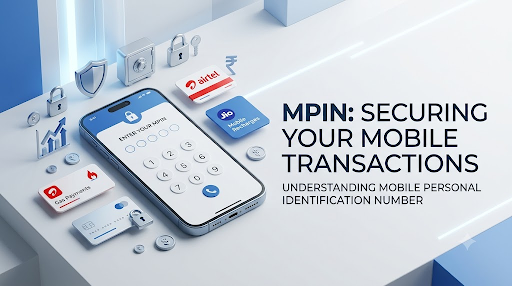
The MPIN’s hidden part of the security puzzle in mobile banking.
Mobile banking has transformed the world of banking. In this digital era, where cyber threats are always a possibility, security is of paramount importance. One of the most important components of this security system is the MPIN, or “four number personal identifier” – a four-digit number that acts as the “gatekeeper” between your financial information and shady characters. Having knowledge of the MPIN’s functioning in mobile banking, particularly in applications such as UPI (Unified Payment Interface), can assist users in making confident monetary transactions.By understanding the function of the MPIN in mobile banking, particularly within applications like UPI (Unified Payment Interface), users can navigate monetary transactions with self belief.
The MPIN is a simple and effective security measure. The four numbers of an MPIN are meant to be easy to remember, yet still secure; unlike traditional passwords, which can be complex and hard to remember. This helps users to remember and allows for transactions to be authorised only by a user with this one-of-a-kind identifier. With the surge in mobile banking in India, billions of transactions are made via UPI alone, it is crucial to understand what the MPIN is and why it matters when it comes to financial protection.
How does the MPIN function in the Mobile Banking?
For those who make transactions using mobile banking apps such as the ones used to make UPI payments, it mandates that the MPIN be authenticated. This is usually done as follows: Step one, enter the recipient information and amount to transfer. After verifying these details, it will ask you for your MPIN. As soon as the four digits are entered, this information is encrypted.
This encryption process ensures that your MPIN is not sent in plain text, or stored in an unsecured way, and thus makes intercepting it much more difficult. The transaction is then completed, and a secure receipt is generated by your banking app. This user verification by MPIN and the protection against it through encryption creates a robust security ecosystem, very much needed in today’s transactions, which are happening on multiple occasions in a day.
These security features are regulated by specific measures. For example, the Reserve Bank of India (RBI) has laid down very clear guidelines that include implementing extra authentication methods like the MPIN to safeguard consumer interests. This increases the level of confidence amongst users and promotes their trust when choosing mobile banking solutions.
The following are some common mistakes that need to be avoided when using MPIN.
The MPIN is a reliable security feature for mobile banking, but users can make certain mistakes that can jeopardize their financial security. A frequent error is using an easily guessed MPIN, such as a birthdate or a series, such as “1234”. The more cryptic an MPIN, the better the security.
Another error is giving the MPIN to other people. Unauthorised access can result from the deliberate or inadvertent sharing. It’s essential to treat your MPIN like any other sensitive password—do not disclose it, and ensure that your device is secure.
One lesser-known issue is that you don’t change your MPIN often enough. The security protocols used may be subject to change, which may necessitate users needing to update their credentials periodically. Updating your MPIN decreases the potential for problems with outdated access codes that could have been hacked into over time.
Finally, when entering your MPIN, it is important that you don’t use public Wi-Fi networks to make transactions. These are public networks and open to a range of cyber threats, which could mean that your transaction might be intercepted. For bank related activities, always take into consideration a more secure connection.
You can pay using Bajaj Pay.
For the users, mobile money transfer without any charge is also an attractive option with the Bharat Connect payments platform launched by Bajaj Finserv on the Bajaj Pay platform. It works like a charm on the Bajaj Finance App and website, and can be done using UPI, credit cards, and other payment options.
To make payments on Bajaj Pay, enter your mobile number and click on the biller/receiver, enter the amount and click on MPIN to authenticate and make the payment. Once payment has been confirmed, you will receive an instant receipt of the transaction to your registered email or phone. The user will also be able to earn rewards on Bajaj Pay, which will ensure a better user experience.
Conclusion
The MPIN represents a critical aspect of security in mobile banking, especially within the ever-expanding ecosystem of UPI transactions. With the increasing adoption of digital finance, knowing how to use the MPIN is essential for financial security, but caution needs to be taken because of popular mistakes made. In the case of Bajaj Pay, users can safely make transactions without fear of any fee, and they know that their information is well-protected thanks to the MPIN system. Make use of this contemporary approach to banking but stay alert for security concerns.