op
What is the one challenge that professionals working on digital platforms never want to face?
- Lack of Traffic?
- Changing Algorithms?
- Rising Competition?
Certainly, these are common challenges associated with building websites. What concerns them most is poor website speed and performance. In 2026, performance is directly connected to user trust, SEO visibility, and even brand perception.
This year is unique in that speed optimisation involves more than just compressed pictures and caching plugins. The WordPress speed ecosystem as a whole is evolving. Performance-first website strategies are becoming more popular among developers, hosting firms, search engines, and business owners. And, this is exactly why you have to read this guide to know how the trends are shifting.
What Is WordPress and What Is It Used For?
WordPress is a widely used content management system (CMS) for creating and managing websites, even if they require no advanced coding skills. It allows users to create blogs, business websites, online stores, and portfolios using customisable themes, plugins, and an intuitive dashboard. Because of its adaptability, scalability, and user-friendly interface, WordPress continues to power millions of websites globally in 2026.
With customisable themes, plugins, and content management capabilities, it assists people and companies in creating a variety of websites. WordPress can be used to create:
- Personal webpages and blogs
- Corporate and business websites
- Online retailers
- Websites for portfolios
- Platforms for magazines and news
- Websites for education
- Platforms for reservations and membership
- Websites for marketing and landing pages
One of the primary reasons it continues to be one of the most popular website-building systems worldwide is its adaptability.
Why Is WordPress Performance Taking the Spotlight in 2026?
Over the past few years, the digital landscape has evolved significantly. Nowadays, websites must be able to manage interactive content, AI-powered tools, video-heavy layouts, mobile-first experiences, and real-time customer engagement.
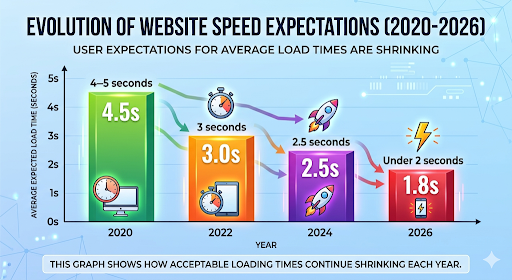
On the other hand, users have become impatient. Even a one-second delay can significantly reduce conversions and user engagement. This pressure is encouraging businesses to prioritise performance from the very beginning of the website development process.
What Is the Biggest WordPress Performance Change Happening Right Now?
Speed has become part of a brand’s identity.
It was a time when businesses were primarily interested in visual design a few years ago. In today’s world, consumers equate lightning-fast loading websites with professionalism and trust. Even a modern website can appear outdated if it loads slowly.
Why Does This Matter for Businesses?
The recognition of the role of branding in a company’s overall success has made website performance a top priority within customer perception. Businesses focusing on company profile design Abu Dhabi understand that strong branding must be supported by a fast, reliable, and user-friendly website experience.
The Psychological Impact of Quicker Websites
The responsiveness of a website is a common factor that is assessed subconsciously by visitors when they rate the quality of a business. Smoother emotional interactions result from faster experiences, and that is why WordPress is undoubtedly a great option for such approaches.
How Does AI Impact Website Performance?
Why Are AI Optimisation Tools Becoming Mainstream?
In 2026, AI-driven optimisation systems have become one of the most significant developments in website performance. These tools automatically compress images, remove unnecessary scripts, predict caching behaviour, and optimise database activity. It is now a noticeable trend in WordPress speed and performance tooling.
Website owners no longer need advanced technical expertise to improve performance. Now, owners no longer need specialised technical knowledge to make a big difference in website speed.
Automation Is Replacing Manual Optimisation with Smarter Options
Modern WordPress optimisation is becoming more advanced, and many tools now adjust performance parameters dynamically and instantly, rather than requiring manual settings maintenance.
How Mobile-First Performance Is Driving a New Era
Mobile devices now account for the majority of website traffic worldwide. By 2026, more than half of WordPress visitors will be on mobile devices.
That has changed the way that developers approach their WordPress websites, and they are putting mobile-friendly and lightweight design at the top of their priorities.
The Importance of a Quick Mobile Page Response Time
A website can be quite speedy on a desktop but become slow and annoying on mobiles. WordPress provides many tools that help address these performance challenges, and your website will operate efficiently regardless of any digital platform. Excessive graphics, autoplay videos, and animations are being minimised for better mobile usability.
What Role Does User Experience Play in WordPress Speed and Performance?
Speed and Usability Now Go Hand-in-Hand
In the past, website speed was often viewed as a purely technical metric. By 2026, companies will know that the speed of their business impacts customer behaviour.
Interactive tools, for instance, such as a digital business card, must be instant as users look for seamless experiences across devices.
Why Are Users Becoming Less and Less Patient?
On hundreds of digital platforms, people interact every day. Online users are now accustomed to receiving quick results from fast apps and platforms. For beginners, focusing on the fundamentals remains the most effective approach.
It is common for website owners to go for tricks and techniques that require advanced skill and knowledge straight away, while the basic optimisation techniques are still in the process of taking root. The following are the best starting priorities,
- Reliable hosting
- Lightweight themes
- Optimised images
- Limited plugins
- Mobile responsiveness
It has become quite important to grasp the basics of WordPress speed according to the trends that are currently operating in 2026. A stable and effective execution generally results in larger gains than finely tuned technical adjustments.
FAQs
Why is WordPress speed important in 2026?
In 2026, website performance has an impact on user experience, conversions, SEO rankings, and general brand trust.
Do lightweight themes perform better?
Indeed. Compared to heavy multipurpose themes, lightweight themes typically load more quickly and cause fewer performance problems.
Does hosting have a big impact on WordPress speed?
Of course. Website stability, server response time, and loading speed are all directly impacted by hosting quality.
How many plugins are too many?
There is no exact number, but unnecessary plugins can significantly delay websites and create technical issues.
Can beginners enhance their own WordPress performance?
Absolutely. For non-technical users, increasing website speed is now considerably simpler because of modern optimisation tools and managed hosting platforms.
Where Is the Future Leading Towards?
In 2026, WordPress performance is closely linked to branding, customer trust, SEO visibility, and business growth. Technical optimisation alone is no longer enough to meet market expectations, which is now shifting towards sleek design, easy-to-understand layout, AI-powered and mobile-centred experiences. When your website meets these standards, you ultimately stand out among the competitors.