
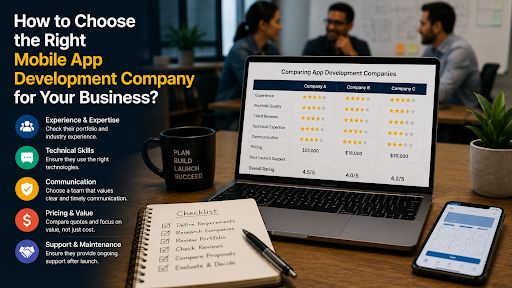
How to Choose the Right Mobile App Development Company for Your Business?
A friend of mine spent four months and almost $40,000 with an agency that, by the end, hadn’t shipped anything usable. Not because they were incompetent exactly. They just weren’t the right fit for what he was building, and nobody figured that out until month three.
That’s the story behind most bad agency hires. It’s rarely “we picked a scam artist.” It’s “we picked a perfectly fine mobile app development company that happened to be wrong for this specific project.” Different specialty, different size, different way of working than what the project actually needed.
So let’s go through how you actually vet one of these firms properly, what questions separate the teams worth hiring from the ones that’ll waste your time and money, and what red flags tend to show up before things go sideways.
Start with what you’re actually building, not who’s available
Before looking at a single agency for Mobile App Development , get specific about the project. Vague briefs produce vague matches, and vague matches are how my friend ended up with the wrong team for four months.
What platform — iOS, Android, both? Native or cross-platform? Does this need a backend with real infrastructure, or is it mostly client-side? Any compliance requirements, healthcare data, financial transactions, anything regulators care about? What’s the actual timeline, and is that timeline realistic or aspirational?
Write this down. One page, maybe two. Every agency you talk to should get the same brief, because comparing apples to apples only works if you’re handing everyone the same apple.
Look at portfolio work that actually matches your project
This sounds obvious and somehow still trips people up constantly. A gorgeous portfolio full of consumer social apps tells you very little about whether that team can build a B2B logistics tool with three different user roles and a janky legacy API to integrate with.
Ask for case studies in your specific category, not just impressive-looking screens. And ask harder questions about those case studies — what was the actual scope, how long did it take, did the timeline slip, what would they do differently next time. Agencies that answer that last question honestly, the “here’s what we’d change” one, are usually more trustworthy than the ones who insist every project went flawlessly. Nothing goes flawlessly. Ever.
Check references too, actual phone calls, not just testimonials posted on their own site. Ask the reference one blunt thing: would you hire them again? The hesitation in someone’s voice tells you more than the words do.
Figure out where the cost actually sits
Pricing varies wildly across this industry, and the variation is usually about specialization and location more than quality. A team that’s built a dozen fintech apps with proper compliance work behind them will charge more than a generalist shop, and that premium is often justified given what’s at stake if compliance gets botched.
Get a detailed breakdown, not a single lump number. A reliable gojek clone app development company should itemize expenses for design, development, QA, project management, and post-launch support so you can see where the money’s actually going.
It also helps to understand typical mobile app development cost ranges going in, so you can tell whether a quote is reasonable for what you’re asking for, or whether someone’s either lowballing you to win the deal (and planning to make it back in change requests later) or padding the number because they sense you don’t know better. Knowing the market rate is leverage. Without it you’re negotiating blind.
Ask about their actual process, not their marketing description of it
Every agency website says “agile” and “collaborative.” That tells you nothing. Ask specifically: how often will we talk, what does a typical sprint look like, who’s my actual point of contact day to day, and what happens when something goes wrong mid-project.
Pay attention to who answers these questions in the sales call. If it’s a senior person who clearly knows the day-to-day reality, good sign. If it’s someone reciting a deck who can’t answer a follow-up question without “let me check and get back to you,” that’s worth noting. Not disqualifying necessarily, but worth noting.
Ask, too, what happens if you want to change direction halfway through. Every project shifts at least a little once real users or stakeholders see early versions. Teams with a clear, fair change-request process handle this fine. Teams without one tend to either bill you a fortune for “scope creep” or quietly cut corners to stay on budget, neither of which you want.
Watch for the red flags that show up early
A few things tend to predict trouble down the line, and they usually show up before you’ve signed anything if you’re paying attention.
Pressure to sign fast, with discounts that expire in 48 hours, is a sales tactic that has nothing to do with the actual work and everything to do with closing deals before you can think it through. Quotes that are dramatically lower than everyone else’s, with no real explanation for why, usually mean corners are getting cut somewhere you won’t see until later. Vague answers about who actually owns the code and the intellectual property once the project wraps — get that in writing, always, no exceptions. And teams that can’t clearly explain their QA and testing process at all are telling you something important about how the finished product is going to hold up.
On the flip side, a few things are genuinely reassuring. Teams that ask you tough questions back, instead of just nodding along to everything you say, are usually the ones who’ve shipped enough projects to know which assumptions tend to blow up later. Teams that give you a realistic timeline instead of the timeline you wanted to hear are doing you a favor, even if it stings in the moment.
Size isn’t the deciding factor people think it is
Bigger agencies usually mean more process, more layers between you and the actual developers, and higher overhead built into the price. Smaller shops or even strong freelance teams can move faster and cost less, but you’re more exposed if someone gets sick or leaves mid-project, since there’s less redundancy.
Neither is automatically right. A complex enterprise build with serious compliance stakes probably wants the bigger team’s process and redundancy. A straightforward MVP that needs to launch fast probably doesn’t need that overhead at all, and might actually move slower with it. Match the team’s size and structure to what your specific project can tolerate, not to whichever one looks more impressive on a sales call.
The actual decision
Once you’ve got two or three finalists, the deciding factor usually isn’t the lowest price or the slickest pitch deck. It’s which team understood your problem the fastest, asked the sharpest questions during the sales conversation, and gave you a straight answer when you asked something uncomfortable.
That last part matters more than people expect going in. The agency that tells you your six-week timeline is unrealistic, even though it costs them the deal if you walk, is showing you exactly how they’ll behave once you’re six months into a real contract together. The one that just says yes to everything you ask for is showing you something too, and it’s not the thing you want.
Pick the team that treats the relationship like it’s going to outlast the first release. Because if the app does what it’s supposed to do, it will.
Total Views: 5