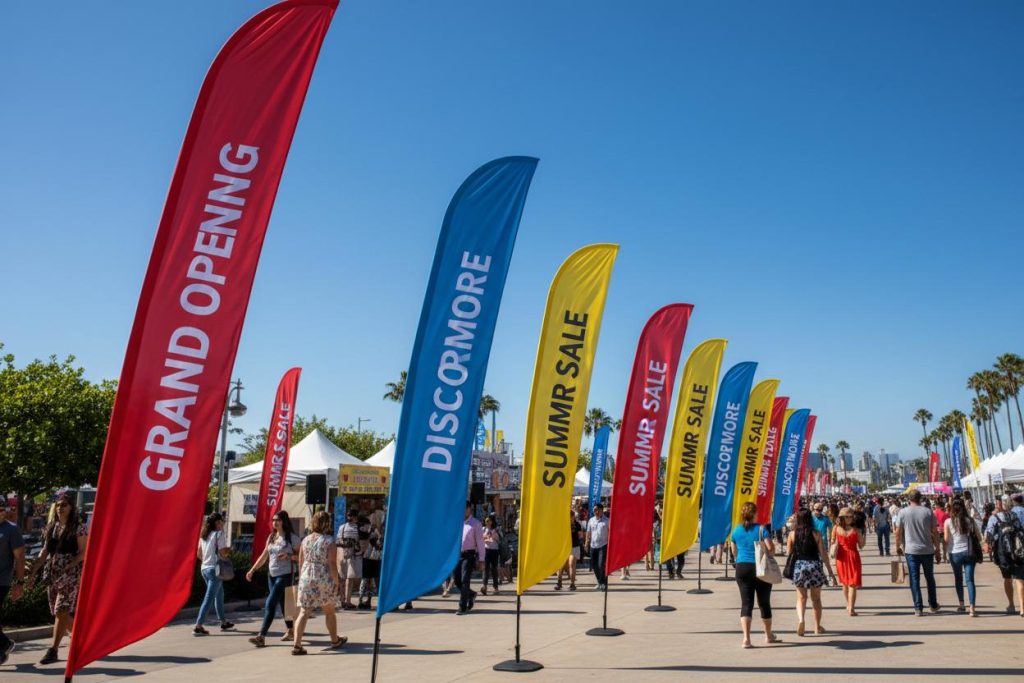
A flag will be viewed at distance (around 40m), it will also be fluttering and half folded so think about how this will affect readability. Banners aren’t much better. Many flags and banners fail as the signmaker will try to fit too much information onto them and use attractive colours. The eight tips for Banner and flag design below address this issue, there are also a few points to note if you’re in Dubai that your signage company Dubai supplies should mention before any money is spent.
1. Work out who’s looking first
What distance will the sign be viewed from and at what speed? A banner above a mall entrance will be read at a leisurely pace. Whereas a flag by the side of a road will be read by somebody driving within a couple of seconds. Sign makers will often work to a rule of thumb of one inch letter sizing for every ten feet. This is the ideal situation. However using lighter colours, decorative fonts or odd angles, you should expect to lose a quarter to a third of this distance.
2. Cut the words, then cut a few more
You won’t be able to fit much more than three to four words on a banner. As flags are narrow you won’t be able to fit as many words. Choose just one thing you want to promote (e.g. your name, offer or “now open”). Don’t put your telephone number as this will need to be read closely.
3. Make the letters stand out from the background
The most safe colour combinations are the dull ones. Black and yellow, white and navy etc. will be legible from far away. Using soft colours on soft colours will make it half the distance that they should be from. Using fat, plain typography will also stand up better than slinky and script fonts.
4. Think about the back of the flag
When designing one sided flags the ink is printed through the material. When viewed from the reverse you’ll see a lighter mirror image of your design. When you know the flag will only be viewed from one side this isn’t too much of an issue. However if they will be approaching from both sides or you have a URL or QR code on the flag you want to pay for the double sided option. This will have two layers of blockout material sewn together. Both of the layers will be printed but in the correct direction. You will be paying more money but if you have any text it is worth.
5. Stay clear of the edges
Flags fold and flap and hide bits of themselves. Hold anything that matters back about 20 to 25 mm from the finished edge. On a flag, don’t put anything along the pole side, because the sleeve swallows it. Banners with hems and eyelets behave in much the same way. A logo pushed right up to the border is usually the first casualty.
6. Trust the proof, not your screen
The screen print is backlit however the fabric will not be. Sometimes brighter blue, neon and black colours will not appear the same. Most feather flags will be printed with a very thin poly (approx 115gsm). This uses a technique called dye sublimation – the inks bind to the fabric. Colour will not run. However, they may not be the same as those displayed on your screen. Get a proof for a cheap way to confirm. If it’s brand colours send Pantone refs through. Note some fluoros and metallics cannot be an exact match.
7. Design for the weather here
In summer your sign will be exposed to the sun & wind. When looking at the design, ask your supplier how well the inks would stand up to the UV. Ask how long the print is likely to last in that climate. On cross bases, you must make sure the water bag is completely empty! Once the first gust hits it will hit the ground. As the fabric is very thin there will be some movement. It should stand up thanks to the base.
8. Permit and Arabic
According to Dubai’s Decree No. 6 of 2020 any advertisement will require a permit. This varies depending on where you will be displaying your ad but can usually be done by bodies like the RTA or your free zone authority. Getting this wrong can result in a fine, removal of your ad or even suspension of your trade licence (up to 6 months).
One law firm summarised ‘it takes less than 10 days to get approved’ but will depend on your application. Make sure you know early on if your signage company Dubai quote includes the permit or just fabrication. Get your artwork finalised before applying for the permit. Once approved you may have to start again if you make any changes.
When you have two languages on your banner you need to decide which will be the main language. Make sure neither font is too small to be read from the other side of the road. Ask someone who reads Arabic natively to review your proof. When copying text from one design programme to another the text can become broken up.
Before Ordering Banner and flag design
In summary there are a few things to consider. Where will it be displayed? Who will see it and from how far away? Who needs to approve it? A good signage company Dubai business will ask these questions before giving you a quote. If they don’t make sure you ask!