Business intelligence has always had an access problem. The tools were powerful but complex. The insights were valuable but locked behind technical expertise. The result was a persistent gap: organizations collected vast amounts of data but only a small fraction of their people could actually use it.
Natural language business intelligence is closing this gap — and the implications for how businesses operate are profound.
What Is Natural Language BI?
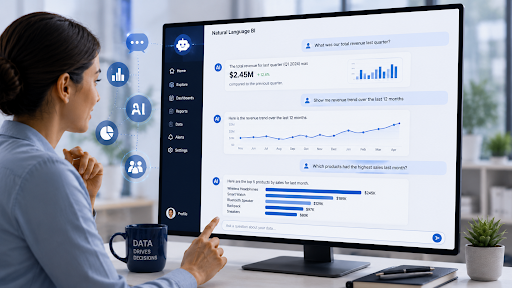
Natural language BI refers to analytics platforms that allow users to query data using everyday language rather than technical query syntax. Through AI-powered conversational analytics, a user can type “What was our best-performing product category last month?” or “Compare our conversion rate this quarter versus last year” and receive an immediate, accurate, visually presented answer.
The underlying technology — a combination of natural language processing, machine learning, and semantic data modeling — translates conversational queries into database operations and presents the results in intuitive formats. The user experiences none of this complexity. They just ask and receive.
Why This Changes Everything
The impact of natural language BI is not primarily technological — it is organizational. When data becomes accessible to every function without specialist mediation, the entire organization becomes more analytical.
Marketing teams stop making decisions based on platform-specific vanity metrics and start looking at cross-channel attribution. Operations teams stop relying on weekly email reports and start monitoring logistics KPIs in real time. Finance teams gain the ability to explore P&L data interactively rather than waiting for month-end closes.
The speed of insight improves. The quality of decisions improves. And the data team is freed from routine report building to focus on higher-value strategic analysis.
Applications in Ecommerce
In ecommerce specifically, natural language BI creates daily value across multiple functions:
- “Which ads drove the highest ROAS last week?” — answered instantly for any campaign manager
- “Show me inventory days remaining for our top 20 SKUs” — available to any operations planner
- “What is our repeat purchase rate for customers acquired in Q1?” — accessible to any analyst
- “How did our email revenue compare to our paid social revenue this month?” — visible to any marketing leader
The Self-Service Foundation
Natural language BI works best when it is built on a strong self-service data analytics foundation. This means clean, well-structured data pipelines, semantic layers that translate technical field names into business-friendly language, and access controls that ensure users see relevant data without exposure to sensitive information outside their purview.
When this foundation is solid, natural language interfaces become genuinely powerful tools rather than impressive demos that cannot handle real-world data complexity.
Overcoming Skepticism
Some organizations approach natural language BI with healthy skepticism — worried about accuracy, data governance, or user adoption. These are legitimate concerns. The best platforms address them through rigorous semantic modeling that ensures queries are interpreted correctly, clear provenance tracking that shows where each answer comes from, and gradual rollouts that build trust over time.
The goal is not to replace analytical rigour with conversational convenience. It is to make rigorous analysis accessible to more people, more often.
The Road Ahead
Natural language BI will continue to evolve rapidly. Multimodal interfaces, voice queries, and proactive AI agents that push insights to users without being asked are already emerging from leading platforms. The trajectory is clear: data access will continue to democratize, and the barrier between a business question and a data-backed answer will continue to shrink.
Conclusion
The era of data being locked away from most of an organization is ending. Natural language BI is not a feature — it is a new paradigm for how businesses relate to their information. The organizations that embrace this shift early will build analytical cultures that compound in value over time. The ones that wait will find themselves competing against businesses that simply make better decisions, faster.