
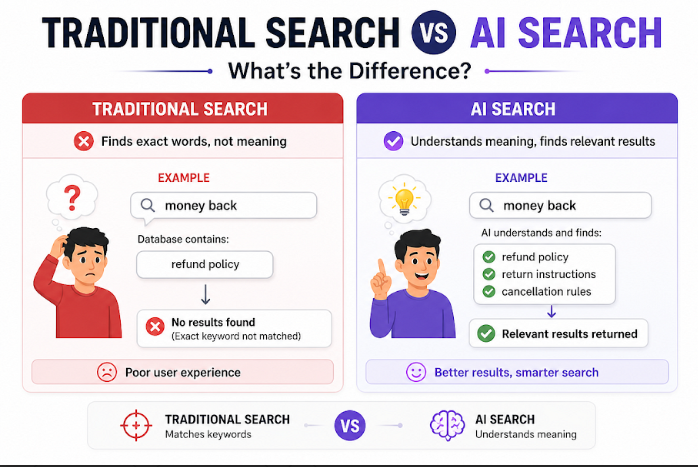
How Traditional vs AI Search Engines Are Shaping the Future of Online Search
Information retrieval methods on the Internet are developing at an unprecedented pace. Classic search engines have dominated the internet landscape for decades by delivering information about websites and documents through keyword-based searches. However, things are about to change drastically thanks to AI-powered search engines.
While classic search engines provide a list of links in blue, AI search engines are designed to understand user intent, produce answers, and deliver faster, more personalized results. Not only does this represent a significant shift in how we search for information, but it also changes how content marketers, SEO experts, and businesses as a whole approach their audience.
So, what exactly is traditional vs AI search engines about? And what does it mean for the future of online search?
Let’s dive in.
Understanding Traditional Search Engines
Conventional search engines like Google and Bing use crawlers and indexing systems to scan sites and rank pages by relevance.
Once the user types in a query, the search engine scans the index and provides results according to various parameters such as:
- Keywords
- Backlinks
- Authority of the site
- Speed of the page
- Relevance of content
After that, the user needs to go through all the multiple links to get the required information.
It has been functioning smoothly for many years, but one problem with this method is that it concentrates on keyword matching rather than interpreting the true intention behind the search.
For example, if a user searches for “the best laptop for students,” a conventional search engine will return all the relevant web pages for the term, but will still require comparison across different sources.
What are AI Search Engines?
AI-driven search engines use machine learning and natural language processing to determine the meaning of the search and deliver answers.
Unlike regular search engines that simply find matches, AI-based engines can determine the user’s needs and deliver the most accurate information right away.
This is especially helpful for users searching for specific services, such as resume writing services Calgary. AI can instantly identify whether the user is looking for professional resume writers, pricing details, or expert career assistance in that area.
There are examples of such engines developed by Google, Microsoft, and even OpenAI.
An AI-driven search engine does not simply show a list of links. Rather, it can provide a summary of the information or compare things right then and there.
This makes searching significantly easier for users.
From Keywords to User Intent
One of the most significant shifts is the transition from keyword matching to intent analysis.
Classic search algorithms favour exact matches. This is why website owners have been optimizing their sites for keywords for decades now.
Modern AI-based searches are trained to interpret natural language. Users can enter queries as if they were asking another human being:
- “Which phone model will last longest on a single charge at $500?”
- “How do I learn graphic design the fastest way?”
- “What online marketing services should I use for a small business?”
AI algorithms not only scan for keywords but also analyze the intention behind them.
In other words, website owners can’t rely solely on keyword stuffing and optimization anymore.
Faster Answers, Fewer Clicks
The traditional approach involved a lot of clicks, comparison of different sources, and extracting of the necessary data by the user himself.
With AI-powered searches, this process has been significantly reduced by the provision of instant, summary results.
If one queries, “What are the benefits of email marketing?”, the AI-driven engine would automatically create a shortlist of email marketing advantages for them without having to visit several sites.
This has brought about drastic changes in users’ behaviour.
Users now expect immediate results. What we call zero-clicking is both a blessing for the user and a curse for the site owner, since the former means the site generates no organic traffic.
Search Is Becoming More Conversational
Traditional searches are generally transactional in nature:
Searchers typically input short queries such as:
- “best phones 2026”
- “SEO tips”
- “weather today”
On the other hand, AI-powered searches are more conversational.
Users now ask:
- “What phone should I buy for taking pictures in 2023?”
- “What SEO tips can you share for beginners to help their small business rank higher?”
- “Do I need an umbrella today?”
AI-powered search engines allow follow-up questions, retain context, and enable interactive conversations.
The shift from transactional searches to conversational searches has implications for how businesses create their content.
Personalization Is Getting Smarter
Search engines of the past personalized searches according to the location, browsing history, and behaviour of the user.
AI-powered search engines take personalization even further.
With the aid of intent analysis, preference analysis, and context analysis, AI can provide more precise responses. Two people making the same query may receive different results because of their intent or behaviour.
A person new to digital marketing might receive suggestions for learning materials, whereas an experienced marketer might be shown analytics tools.
SEO Strategies are Rapidly Evolving
It seems the biggest effect that AI search engines have had is on SEO.
Old-school SEO strategies were all about:
- Keywords
- Backlinks
- Metadata
- Position ranking
But while all those things are still relevant, with AI search engines, it’s all about:
- Relevance
- Quality content
- Authority
- Answering user needs
In other words, what companies need to do is craft content that answers their customer’s questions accurately, builds their trust, and establishes authority on the topic.
For example, when someone searches for “top resume Canada,” AI search engines prefer content that provides useful comparisons, expert advice, and clear answers. They do not favour pages that only repeat the keyword.
Rather than focusing on keywords and search engine rankings, they should write articles that actually help users. It’s about making useful content, not stuffing keywords anymore.
The User Experience is More Human
The process is mechanical when people search using conventional means. They key in certain terms and sift through the search results.
AI search is conversational. Users receive answers, suggestions, clarifications, and recommendations. It becomes easier for the search experience to become human-centric.
It translates into convenience for the end user and competitiveness for organizations. Companies must generate high-quality content to gain visibility in AI-powered searches.
Organizations that add value will dominate in the new era.
Frequently Asked Questions
- What is the primary distinction between traditional and AI-based search engines?
The former provides users with a ranking of websites according to the chosen keywords. The latter not only understands the purpose of the search but also gives direct answers to questions.
- Are traditional search engines going to be replaced by AI search engines?
Probably not, but people are starting to prefer using AI search engines for immediate answers to their questions.
- How can we prepare for AI search engines?
SEO should shift from focusing on keywords to centring on producing high-quality, user-relevant content.
The Future of Search
Traditional search engines won’t become obsolete overnight. They provide general access to web content and remain indispensable in the discovery process. However, in the evolving landscape of Traditional vs AI, AI-driven search engines are setting new standards.
Search engine users want:
- Instant results
- Interactive dialogues
- Personalized suggestions
- Accurate synopses
With AI becoming ubiquitous in search, the line between search engines and virtual assistants will keep getting thinner.
The future of search is about more than just connecting the dots. It’s about connecting information to deliver meaningful solutions.
In today’s digital world, content producers, marketers, and businesses must adapt to survive. Individuals who know what AI search is capable of today will have a distinct advantage tomorrow.
Total Views: 19