
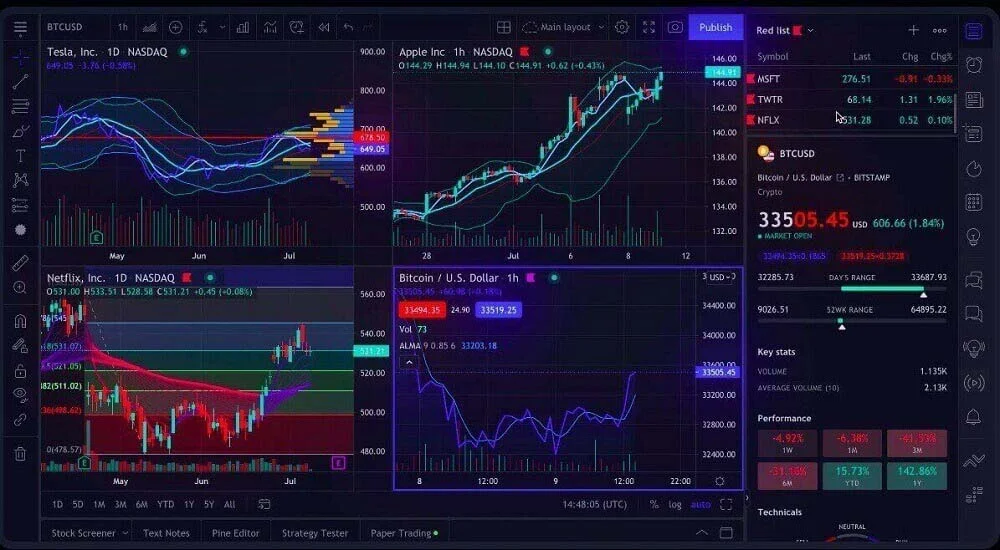
What TradingView Charts Reveal About Price Behavior That Most Traders Ignore
Price leaves footprints that most traders pass over without a second thought. The obsession with entry cues and profit targets tends to crowd out quieter observations, the kind that accumulate into a genuinely useful body of knowledge about how a particular instrument behaves. A stock that consistently stalls at round numbers, a currency that reliably spikes and reverses at a particular session overlap, a commodity that consistently respects a particular moving average on the weekly chart but ignores it entirely on the daily. These are behavioral fingerprints visible not to every passerby but to those trained to look for the right things.
Candle bodies and wicks represent one of the most consistently overlooked aspects of price behavior. A series of candles with long upper wicks approaching resistance is not merely a visual curiosity. It is recurrent rejection, sellers repeatedly overpowering buyers across multiple attempts. Traders who study that kind of detail on TradingView charts begin to develop a sense of when a level is genuinely being defended, rather than one that has simply been marked important because it is a round number or a historical reference point. The practical implications of that distinction for trade sizing and management are significant.
Volume tells a parallel story that many chart readers relegated to secondary status. A breakout from a consolidation zone on low volume carries a very different implication than one accompanied by a surge in activity. The directional move may look identical in both cases, yet the conviction behind it is different. One trader who had spent months studying equity breakouts noted that when they began filtering by volume, it was the moment their perception of price behavior changed permanently. What had previously appeared to be clean breakouts began revealing themselves as traps, while those with genuine follow-through became easier to identify.
Another behavioral pattern that deserves closer attention is gaps. A gap is an area where the price has not been traded and it has left a blank area with no trading history. Price tends to return to such zones, not for any mystical reason, but because orders that were active before the gap tend to remain relevant once price returns. Traders who track unfilled gaps as part of their structural map gain a layer of context that purely indicator-based approaches are likely to miss entirely.
Price behavior at previous swing points deserves more emphasis than mainstream trading education typically gives it. As price approaches a level that once acted as support and now functions as resistance, the interaction at that level is rarely clean or immediately clear. Tracking the price action in the hours and sessions leading into that test, the speed of approach, the size of candles, and the presence or absence of follow-through is where TradingView charts provide a genuine analytical edge. The platform’s ability to annotate and save those observations allows a trader to build a living record of how specific levels have behaved historically.
The repetition of behavioral patterns over time is probably the least exploited source of insight available to any chart reader. Markets are not mechanical in their nature. They are the aggregation of decisions made by participants whose psychological tendencies remain relatively consistent. The fear of loss, reluctance to buy at previous highs, the tendency to chase momentum and exit too early are all recorded in the chart. When a trader reads those marks not as points on an abstract grid but as the expression of human behavior, they build a layer of interpretation that transforms chart reading into a more genuinely human understanding of the market, one that accumulates over time in a way no shortcut can replicate.
Total Views: 14