AI or Artificial Intelligence has revolutionized the way digital marketing is working in the current scenario. Things were different earlier as earlier marketers used to depend heavily on manual efforts, guesswork, with let’s give it a try and see as well as trial-and-error strategies.
Now, AI allows marketers to make smarter decisions backed by data, automations, and a bit more predictive insights. So, irrespective of whether you are creating content to analyze customer behavior, AI has added speed, accuracy, and scalability to the same digital marketing efforts.
It has done so in many ways, automation of repetitive tasks, personalized user experiences, real-time data analysis, smarter ad targeting, and improved optimization of content. These advancements help marketers save a lot of time and efforts, reduce costs, and help in achieving better results with less effort. The article will broadly cover the usage of different AI tools in digital marketing.
Key Areas of AI Tools in Digital Marketing
Content Creation and Content Flow
Content is usually where AI enters the picture first. Not because marketers want shortcuts, but because content never really ends. Whether it is blogs, emails, captions, creative content, or ads, content is indeed required.
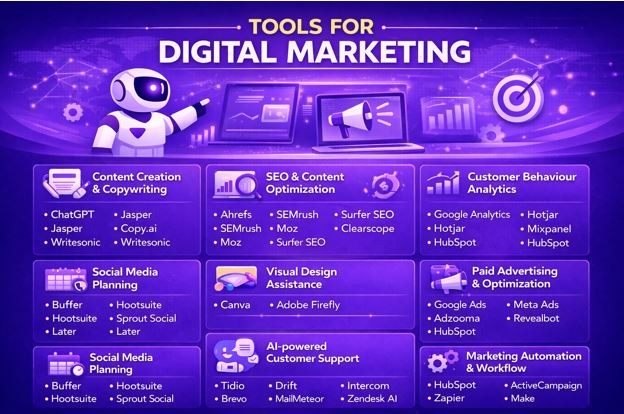
So, there are a lot of content creation tools out there; here are some of my favorites and widely used tools: ChatGPT, Jasper, Copy.ai, and Writesonic help when you’re stuck or short on time. They generate outlines, rewrite clunky sentences, or give you multiple versions of the same idea.
From what I’ve seen, they work best as a starting point. You still need human thinking to shape tone, logic, and intent—otherwise everything starts sounding… the same.
SEO and Search Intent Understanding
Search Engine Optimization (SEO)—you may have heard it to be all about keywords only, but in today’s times things have changed. SEO is more about finding the user’s search intent and their expectation from their search intent so that it could be catered effectively.
With time the concept of Answer Engine Optimization (AEO) has come into the picture, and alongside it has become important as it aligns content with AI systems in order to deliver answers.
So, tools for SEO include Ahrefs, SEMrush, Moz, Surfer SEO, and Clearscope. These tools help the SEO goals to be achieved efficiently by analyzing search behaviour, competitor analysis of their content, also the ranking gaps and all this much faster than humans could ever do. They simply bridge the gap between where we are and where we want to reach ie- Higher Rankings.
Customer Behaviour and Journey Tracking
Users usually don’t navigate through a website in a straight line. So, how do they move, they pause, scroll, bounce, come back later. There’s a lot to keep track which is where AI helps make sense of that mess.
There are tools like Google Analytics 4 (GA4), Hotjar, Mixpanel, and HubSpot, which keep track on how users search behavior and their usual sessions. How do they do? So, instead of just showing numbers, they reveal patterns like where users bounce, what keeps them engaged, and what quietly converts. These insights are beneficial as it often leads to small changes that create big improvements over time.
Social Media Planning and Performance
Managing social media can be tiring when you’re posting often and at the same time trying to track performance.
But there are tools which can do this for you without even getting tired, these are- Buffer, Hootsuite, Sprout Social, and Later they help you to schedule content and analyze engagement. But for visuals there are platforms like Canva and Adobe Firefly that speed up design without need of advanced creative skills. AI doesn’t replace ideas here; instead, it just removes friction so creativity can actually show up.
Email Marketing and Personalised Communication
Email marketing works when messages feel relevant, not random. AI analyzes user interaction over time.
Some famous e-mail marketing tools are Mailchimp, ActiveCampaign, Brevo, MailMeteor and HubSpot. They keep a track on your recipients, help you through AI by optimizing subject lines, sending times, automating follow-ups and content personalization. The changes aren’t loud or instant, but they add up. Better open rates. Fewer ignored emails. More meaningful engagement.
Paid Advertising and Campaign Optimization
Running ads and that too manually can be more like a trial-and-error thing and tends to be a waste of budget. But not now, as AI reduces that uncertainty.
There are many platforms like the popular ones including Google Ads and Meta Ads already rely on AI on the other hand tools such as Adzooma and Revealbot highlight underperforming ads so that scaling opportunities and budget leaks can be checked. From the integration of AI these decisions feel more informed and less impulsive because now AI handles the optimization, and it’s doing the job perfectly.
Customer Support with Instant Responses
No one has patience so do users, they expect their queries to be solved in a fraction of minute as waiting for them is not an option.
For instant replies the widely used AI-powered chatbots include Tidio, Drift, Intercom, and Zendesk AI, step in to handle basic customer questions. They work effectively and reduce the workload for human teams. Customers usually value speed more than perfection, and you know what, AI delivers that.
Marketing Automation and Workflow Tools
Automation uses technology in order to perform tasks with less human assistance. So, automation in marketing does the same. It saves a lot of time by automating a whole lot of marketing processes. Tasks like sending emails, follow-ups, assigning leads, tagging users all these are taken care through automations and to do so tools like HubSpot, ActiveCampaign, Zapier, and Make (Integromat) are used which not only reduce errors or saves time but also increase productivity.
So, while automation is taking care of marketing processes employees can focus on other tasks. And let AI handle the boring parts.
Use of AI Tools in Digital Marketing
- Decrement in time and efforts through automation
- Better decision-making via data-driven insights
- Enhanced personalization as well as customer experience
- Increases productivity and marketing efficiency
- Reduces human errors in analysis and execution
- Helps scale campaigns without increasing manpower
- Improves ROI through better targeting and optimization
Best Practices for Implementing AI in Digital Marketing
Set Clear Marketing Goals
Here’s the catch: before you use any AI tool, have a clear goal about your objective, for example, traffic, getting leads, brand visibility, or conversions. Having a clear goal is necessary; otherwise, AI won’t serve the purpose properly, as AI works best when you have specific goals to accomplish.
Choose the Right AI Tools for the Right Tasks
Each AI tool serves a different purpose, where some tools are great at creating content, while others are good at SEO, analytics, or ad generation and optimization.
Pick the tool that fits your goals well, and don’t go to tools just because they are trending; it will eventually lead towards tension and not results, so choose wisely.
AI coupled with human creativity and judgment
AI should act as a friend, as a supportive thing to marketers, not replace them. Honestly, this part gets ignored too often. AI can suggest ideas, drafts, and numbers—but humans decide what feels right. Tone, context, intent. That’s still on us.
Focus on Data Quality
AI works well when you provide clean data to it; cluttered data when provided to AI leads to bad results. So, it is advised to keep your data clear and submit it the way it is asking you to submit so as to get useful results.
Monitor Performance and Optimize Regularly
If you think that you will use AI and everything will work out, then you are wrong because AI is not magic. You can’t set it up to work and forget a bit of human interference is required for tracking performance, making adjustments, and testing, and a few more requirements have to be fulfilled so that you can get the desired results.
Use AI ethically and respect Data Privacy
It is important to use AI responsibly in the first place as well as to respect user privacy alongside following the required guidelines, as adhering to a cautious and ethical approach should be a choice and not an option.
Conclusion
AI tools have become an integral part of marketing in today’s time. They bring value with them by automating marketing processes, analyzing large data in real-time, enabling personalized user experiences, and making decision-making faster.
According to the McKinsey Global Institute report “The State of AI”, organizations that have adopted AI in marketing have seen visible results in terms of their revenue, customers, marketing efficiency, or overall marketing growth. So, we can say that AI has become an important part of modern marketing, leading towards growth and better experiences.
Author Name- Harshita Singh