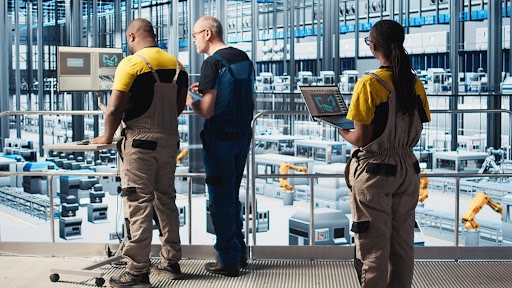
Traditionally, a warehouse or factory floor was completely separate from the office and administration work. This was for a good reason, as on the factory floor, associates usually managed the Operational Technology (OT) like the physical machinery, assembly lines, and programmable logic controllers (PLCs) that actually build products. Whereas in the office, the system administrators (Sysadmins) focused on the IT aspect, which involved handling emails, databases, and servers.
However, now in 2026 and beyond, businesses are transitioning to smart factories, i.e., connecting industrial machinery to the internet and even using AI-powered machines to improve efficiency and data collection. Now, it is great for productivity, but it has left factories with massive security gaps. As for Sysadmins, now, their role is not just protecting data, but safeguarding physical machines as well due to an increase in cyber attacks on machinery.
Now, if you are thinking of entering the cybersecurity field, more precisely becoming a Sysadmin in a factory setting, here’s what you need to know.
Understanding the OT Security Gap
When it comes to understanding cybersecurity of operational technology, most people often get confused and think that cyber attacks are not a threat to such settings.
However, when it comes to cybersecurity (even in factories), every piece of data must be protected, as cyber criminals can leverage even a measly amount of data, as a line of code for a machine can act as leverage for ransomware.
This is why keeping data private, ensuring it isn’t changed, and making it only available when needed is essential.
| Quick InfoWhat’s Ransomware? It’s a software used to extort money from individuals and businesses by blocking or corrupting important data. |
Additionally, it’s important to think in terms of impact on productivity with such attacks. As a DDoS attack in an IT company means 30 minutes of downtime (given it is sorted by cybersecurity professionals); however, in a factory, it means a robotic arm completely coming to a stop, and the business losing hundreds of thousands of production value.
The Rise of Industrial Cybersecurity Specialists
As mentioned at the start, engineers and Sysadmins used to work completely separately. While it is still the case, businesses require a professional who can handle the cybersecurity of OTs, but also understands the workings of a factory floor.
This has created a massive demand for a new kind of professional: the Industrial Cybersecurity Specialist, who are Sysadmins who can implement the following:
1. Segmenting the Network
Having both OTs and office devices connected to the same network increases the risk of digital attacks. This is why skilled Sysadmins create vulnerable zones that isolate critical machinery from the devices.
2. Managing Legacy Systems
Since almost all industrial machinary are expected to run for decades, these are often subject to outdated software that cannot be easily patched, which makes them vulnerable to attacks. Modern Sysadmins should understand this well and must find solutions, implement patches, and protect these legacy machines without compromising functionality.
3. Monitoring for Anomalies
In an office, a spike in data at 2:00 AM might just be an automated backup. On a factory floor, a machine suddenly trying to communicate with an unknown IP address in another country could indicate a breach. Skilled Sysadmins know to implement specialized Industrial Intrusion Detection Systems (IIDS) to watch for these red flags.
How to Pivot into Industrial Cybersecurity
If you are a Sysadmin or an aspiring IT professional, you can also enter a more niche industry as a Industrial Cybersecurity Specialist. Interestingly, you don’t even need a four-year degree to prove your worth; all you need to do is showcase to employers that you have the skills they are looking for.
To gain relevant skills, the quickest path is to enroll in online cybersecurity courses with certificates. These programs allow you to keep your current job while you learn the specific protocols (like Modbus or Profinet) used in industrial settings.
Furthermore, earning a certificate proves to a hiring manager that you understand the unique “safety-first” culture of a factory and that you know how to apply security measures without disrupting production.
Key Skills to Master for the Factory Settings Include:
Network Protocol Analysis: Learning how industrial machines uses network and the server to communicate with other machines.
Risk Assessment: Identifying which machines are most critical and which represent the biggest vulnerability.
Incident Response: Knowing exactly what to do when a machine starts acting suspiciously to minimize downtime.
Hardware Security: Understanding how to secure the physical ports on machines to prevent unauthorized USB access.
Endnote
By bridging the gap between IT and OT, you aren’t just protecting a company’s data—you are protecting its physical output and the safety of its workers. The transition requires a shift in mindset and a specific set of skills, but for those who take the time to earn their credentials through specialized training, the career opportunities are virtually limitless.